What’s in Your Fiber Supplement?
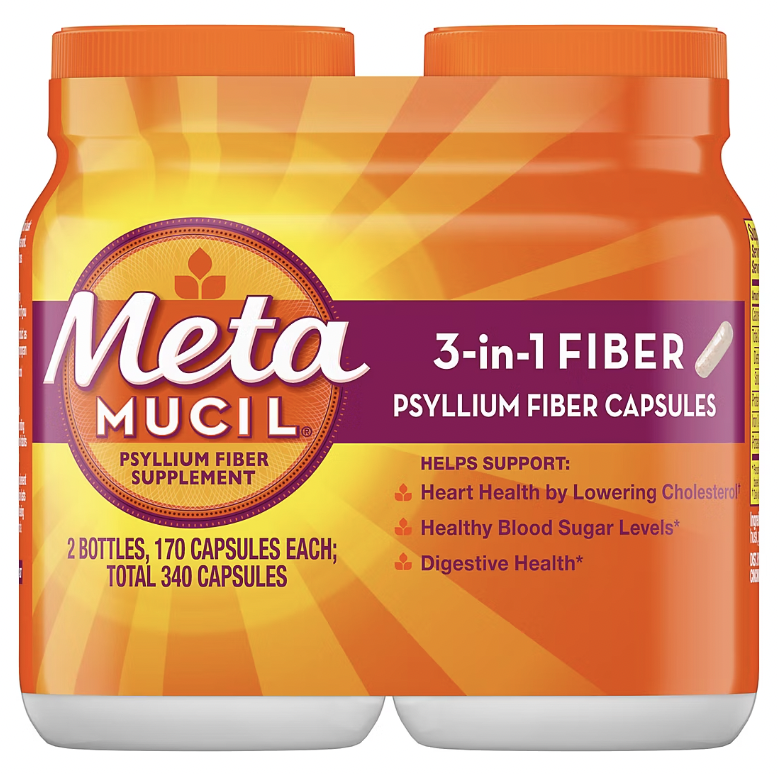
Psyllium husk has become something of a superstar in the world of dietary fiber.
It is inexpensive, easy to add to a daily routine, and remarkably effective at increasing fiber intake. People take it to relieve constipation, improve bowel regularity, support healthy cholesterol levels, and increase feelings of fullness. Psyllium husk is also the primary active ingredient in Metamucil, one of the most widely recognized fiber supplements. But there is an unexpected downside to this otherwise humble plant: some psyllium products contain measurable amounts of lead.
That raises an obvious question: Why would a fiber supplement contain lead in the first place?
Where does the lead in psyllium come from?
Psyllium comes from Plantago ovata, a plant cultivated primarily for the thin coating—or husk—surrounding its seeds. The husk is extraordinarily rich in fiber and is the part that is ground into the powders and flakes sold as psyllium supplements. ConsumerLab describes psyllium husk as roughly 90% fiber, with most of that fiber being soluble. (ConsumerLab)
The most likely source of lead is the environment in which the plant is grown. Lead occurs naturally in some soils, but agricultural soils can also become contaminated by historical industrial activity, mining, pesticides, fertilizers, atmospheric deposition, and other human activities. Plants can take up lead from contaminated soil, allowing it to enter the food supply. The FDA specifically notes that environmental lead can be taken up by plants and subsequently enter foods. (U.S. Food and Drug Administration)
Psyllium may be particularly prone to this problem. Research on Plantago ovata has demonstrated that the plant can take up lead from soil, including accumulation in its husks. One study found that P. ovata could tolerate relatively high concentrations of lead in soil and characterized it as a potential lead hyperaccumulator. (ARCC Journals)
There is another interesting wrinkle: the psyllium husk itself has an ability to bind lead. Researchers have demonstrated that psyllium can adsorb lead ions, which is one reason psyllium has even been investigated for its potential to remove lead from biological systems. (ScienceDirect) That property is beneficial in some experimental contexts, but it also means that trace metals present in the growing environment may end up concentrated in the very part of the plant that people consume.
Where psyllium is grown may also be an important part of the picture. The majority of the world’s psyllium is grown in India, particularly in Gujarat and Rajasthan, and India has a substantial legacy of environmental lead pollution. Leaded gasoline remained in use until its nationwide phaseout in 2000. India has also experienced soil contamination from industrial activity, mining and smelting, waste, and agricultural chemicals. Because lead deposited into soil can persist for decades, the geographic origin and specific growing conditions of psyllium are relevant when considering where lead in the finished product may originate.
This does not mean that all psyllium is dangerously contaminated. Rather, it means that contamination can vary considerably from one product—or even one batch—to another.
Why do people take psyllium?
The basic idea behind psyllium is wonderfully simple: it absorbs water and forms a thick gel.
When consumed with sufficient liquid, that gel increases stool bulk and helps make bowel movements easier. Psyllium is therefore widely used as a bulk-forming laxative and fiber supplement. Its soluble fiber can also slow digestion and contribute to feelings of fullness, while clinical research supports benefits for cholesterol management. (ConsumerLab)
People commonly use psyllium for:
Constipation and bowel regularity
Increasing dietary fiber
Supporting healthy cholesterol levels
Increasing satiety or fullness
Supporting blood-sugar management
Adding fiber to low-carbohydrate or low-fiber diets
It comes in two closely related forms. Whole husks consist of the relatively intact seed coating and are light and flaky. Psyllium husk powder is more finely ground and therefore denser. Because powder packs more psyllium into a given volume, a teaspoon of powder can represent roughly the same amount of material as a tablespoon of whole husk.
How much lead are we talking about?
In 2024, ConsumerLab independently tested nine psyllium-containing products and found detectable lead in every product tested. Four contained amounts that ConsumerLab considered excessive, with the highest product containing approximately 8.5 micrograms of lead per 4 grams of fiber. At manufacturers' maximum suggested daily doses, the lead exposure from some products ranged as high as 38.7 micrograms per day. (ConsumerLab)
ConsumerLab's complete product-by-product results are available only to subscribers, so it is important not to pretend that all of the individual laboratory numbers are publicly available. However, publicly reported results identify several relatively low-lead products, including Organic India and Yerba Prima, while other products tested substantially higher. (https://www.peoplespharmacy.com/)
A look at several commonly available products
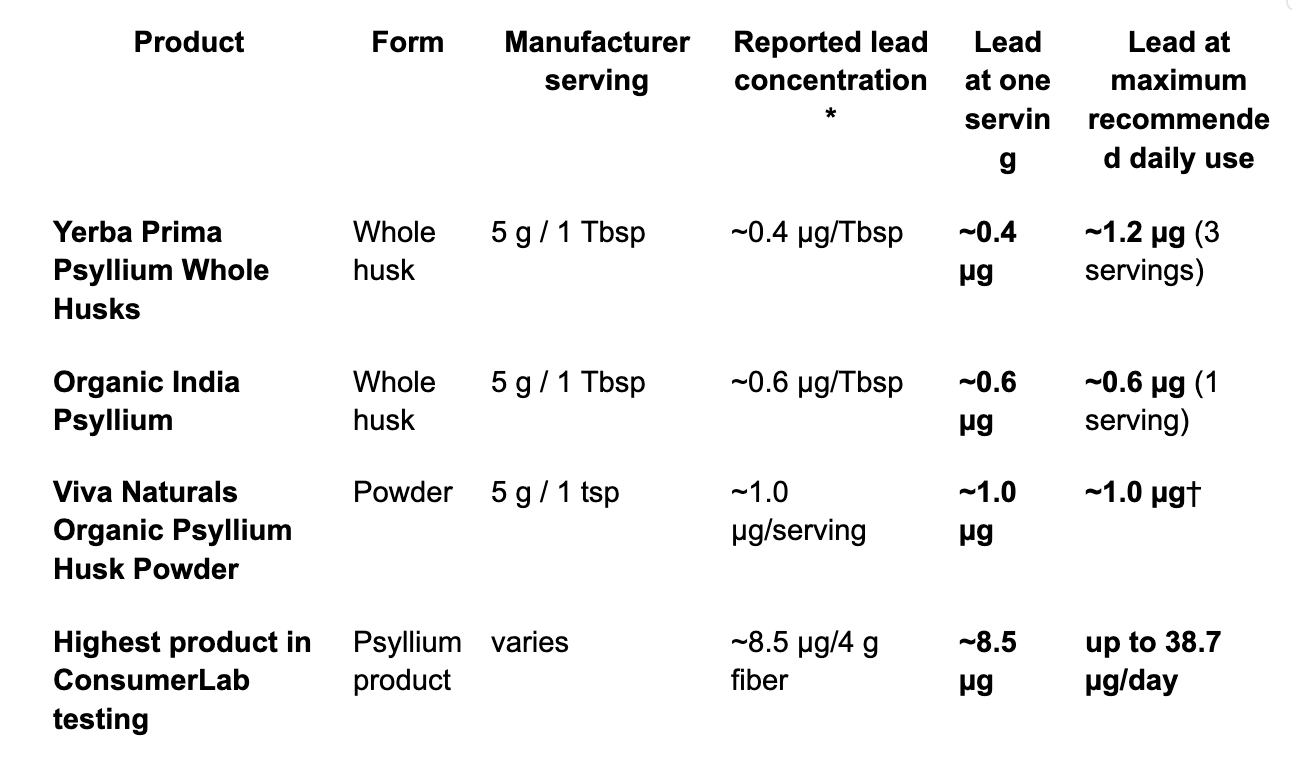
This table combines the publicly reported ConsumerLab lead results with the manufacturers' current recommended serving sizes. The lead measurements are independent test results from ConsumerLab's testing, not amounts printed on the product labels.
* Publicly reported figures are rounded; ConsumerLab's complete laboratory results are behind its subscription service.
† Viva's current product directions recommend starting with one 5-g serving daily; the manufacturer also says to increase gradually as needed. (Viva Naturals)
The comparison becomes more meaningful when we put these numbers beside the FDA's dietary lead benchmarks:
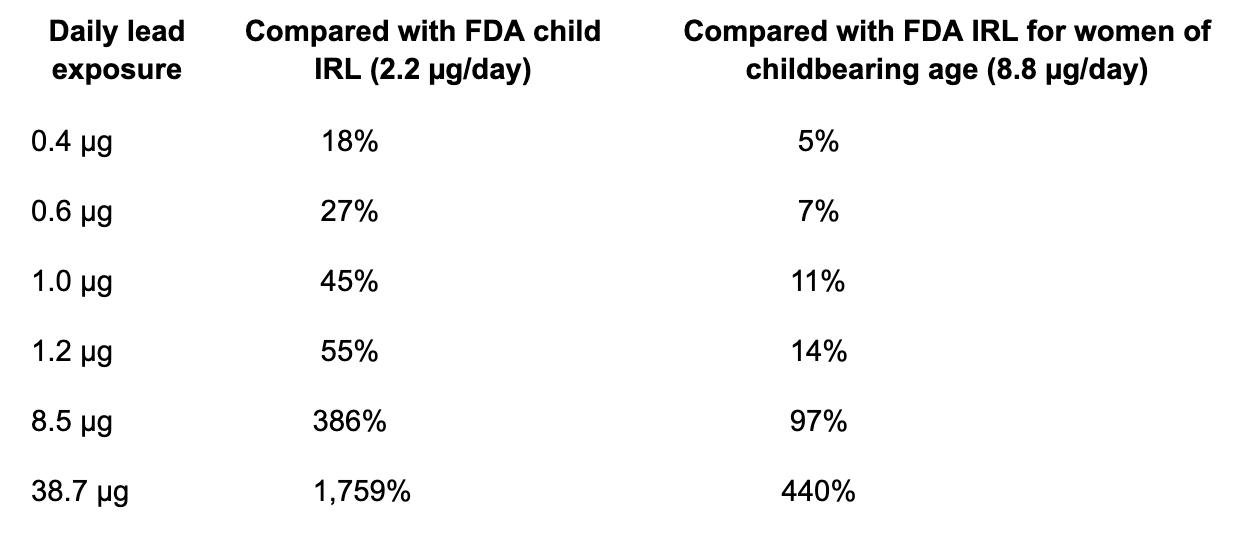
These comparisons should not be interpreted as saying that a product containing less than 2.2 or 8.8 micrograms of lead is “safe.” The FDA explicitly states that no safe level of lead exposure has been identified, particularly for children. The 2.2- and 8.8-microgram figures are reference levels intended to help evaluate potential dietary exposure, not recommended amounts of lead to consume. (U.S. Food and Drug Administration)
Does this mean you should stop taking psyllium?
Maybe, but not necessarily.
Psyllium itself is a useful and well-studied source of soluble fiber. The testing does suggest, however, that brand selection matters.
The striking thing about the ConsumerLab results is the enormous variation between products. Some contained approximately a microgram or less per serving, while another could contribute many micrograms per serving. (ConsumerLab)
For someone taking psyllium every day—particularly a child, someone who is pregnant or could become pregnant, or someone who already has other sources of lead exposure—it makes sense to minimize unnecessary lead exposure whenever possible. (Frankly it makes sense for everyone to minimize unnecessary lead exposure whenever possible.)
Consumers should also remember that “organic” does not mean “lead-free.” Organic certification regulates agricultural practices; it does not guarantee that soil contains no environmental contaminants. Lead is an element, not a pesticide that can simply be eliminated by switching to organic farming.
The practical lesson is therefore fairly straightforward: psyllium can be an excellent way to increase fiber, but it is essential to pay attention to the quality of the particular product. If you take psyllium daily, choosing a product with independent heavy-metal testing and a history of low lead contamination is a necessary precaution.
After all, the goal of taking a fiber supplement is to improve your health—not to add an avoidable source of an environmental toxin to your diet.
What about alternatives?
Because psyllium has a number of different clinical benefits, finding appropriate alternatives will depend on the issue you’re trying to address. Look into partially hydrolyzed guar gum, modified citrus pectin, and whole food fiber as lower lead alternatives. Modified citrus pectin, as a major bonus, is a remarkably effective chelator (it helps get heavy metals OUT of your blood!). Pectsol is a well-regarded brand of modified citrus pectin. Because citrus is not a particularly good bioaccumulator, modified citrus pectin is not likely to contain lead.
*Inulin, methylcellulose, and fructooligosaccharides are also potential contenders, but these will require some investigation as to the presence of heavy metals because of the sources from which they are derived.